Places / On the water
Public boat launches in Minnesota: finding one, and what the law expects at the ramp
How to find a public boat launch, what the DNR says is illegal when you leave the water, the cleaning methods it recommends, child life jacket and registration rules with fees, and what the DNR pages do not say.
Byline pending. Compiled from public sources; awaiting a named contributor. Compiled .
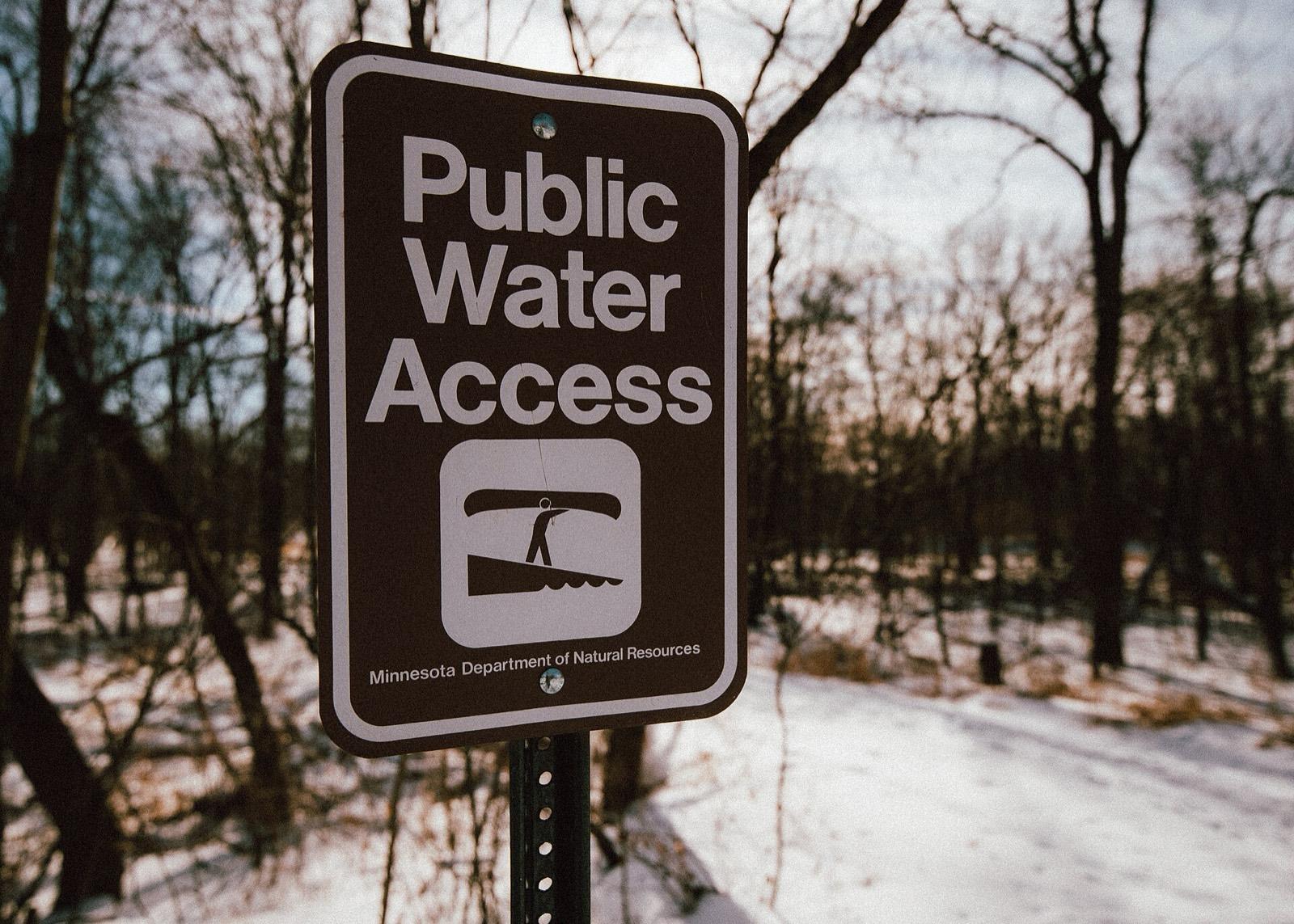
A Minnesota DNR "Public Water Access" sign at the Cannon River Wilderness Area, Rice County, January 2018. Illustrative: it shows the sign style, not a launch this guide covers.
Illustrative. Photo: Tony Webster, CC BY 2.0. Not taken by MNIRL; resized. Credits
What should I do?
Read from the sources below
Who this applies to
Anyone who launches a boat, canoe or kayak at a Minnesota public access.
By when
Before you launch. Drain plugs must be out while you transport the boat, by law.
Whom to call or check
- Minnesota DNR water accessFind an access
- DNR watercraft licensingRegistration and fees
What to do
- Find the access on the DNR's LakeFinder and check the posted hours.
- Register the boat if the rules require it. Registration lasts 3 years.
- Bring life jackets for children under 10.
- At the ramp: pull the drain plug, drain everything and remove what you can see. At home, dry equipment for at least five days if you can.
Rules for a particular lake can be stricter than the statewide ones. Read the signs at the ramp.
Quick read
- Launch fee
- None, unless the access is inside a park that requires a permit
- Hours
- Open 24 hours unless posted otherwise
- Drain plug
- Out while transporting, by law
- Boat registration
- Good for 3 calendar years; canoes and kayaks over 10 feet pay $23 plus a $20 AIS surcharge
A public water access is a simple thing on purpose: a ramp, some parking and a lake. The DNR says accesses are open 24 hours a day unless posted otherwise and that there is no launch fee, unless the access sits inside a park that requires a vehicle permit. This guide covers the statewide rules read from DNR pages on November 6, 2026. It does not review individual ramps.
Finding one
Start with LakeFinder on the DNR's site: search for the lake, then look for Water Access. The DNR also publishes county access maps and the Recreation Compass map tool, and DNR area offices can answer questions. Most ramps handle boats of 12 to 18 feet, so ask before you tow something bigger. The DNR page does not say how many public accesses exist statewide, and it gives you a way to report problems with an access by email.
Leaving is where the rules are
The DNR lists what is illegal plainly. Before leaving, clean off what you can see, drain everything, and put unwanted bait in the trash.
| Action | Rule |
|---|---|
| Drain plug | Do not transport a watercraft with the plug in, or arrive at an access with it in |
| Plants and prohibited species | Do not carry aquatic plants, zebra mussels or other prohibited species on a roadway, or launch with them attached |
| Water | Do not transport water from Minnesota lakes or rivers |
| Bait | Do not release bait into the water; put unwanted bait in the trash |
Beyond the law, the DNR recommends cleaning steps. It says very hot water kills zebra mussels and some other aquatic invasive species.
| Method | Detail |
|---|---|
| High-pressure water | Spray the boat and equipment |
| Very hot water | 120 degrees for at least 2 minutes, or 140 degrees for at least 10 seconds |
| Drying | At least 5 days before moving to another waterbody |
| Before leaving the access | Run the motor a few seconds to discharge water, and drain the bilge, livewell, baitwell and ballast |
Be kind to the ramp
Using the motor to drive a boat on and off a trailer is called power loading, and the DNR explains why it hurts. It digs holes and piles up mounds at the ramp. The DNR's advice is to keep the motor near idle, use the winch, and back in only far enough.
Rules to check before you launch
Children under 10 must wear a life jacket when a watercraft is underway, with three exemptions on the DNR's page. And registration catches more boats than newcomers may expect: the exemption for non-motorized craft covers those 10 feet or less, so a longer canoe or kayak falls under the registration page and costs $23 plus a $20 AIS surcharge. Out-of-state boats may have a 90-day exemption if the home state doesn't license them, so read the page for your boat.
| Watercraft | Registration fee | AIS surcharge |
|---|---|---|
| Canoe, kayak, sailboat, paddleboard | $23 | $20 |
| Pleasure craft under 17 feet | $36 | $25 |
| Pleasure craft 17 to 19 feet | $59 | $29 |
| Pleasure craft over 19, under 26 feet | $113 | $38 |
| Personal watercraft | $85 | $25 |
Common mistakes
Arriving with the drain plug in. Assuming a canoe is exempt because it is a canoe: only 10 feet or less is. Carrying water, such as a bait bucket, away from the lake. Power loading. Assuming a ramp fits a big boat because the DNR says most handle 12 to 18 feet. Forgetting that a ramp inside a park may need a vehicle permit; see our guide to what the permit costs.
What differs by place
The legal rules are statewide. Ramp size, parking, hours posted and fees inside parks differ by access. The DNR provides county maps and area offices for local answers. We did not review any individual ramp.
What to do
Before leaving home: look up the access on LakeFinder, check the ramp's posted hours, register the boat if required and bring life jackets for children under 10. At the ramp: remove the plug, drain everything, clean off what you can see. At home, dry equipment for at least five days if you can.
What we could not confirm
Fine amounts for violations. The number of public accesses. Conditions or crowding at any specific ramp. The three child life jacket exemptions' wording. Other watercraft fee categories beyond those shown. The DNR's registration page shows its example term dates from 2003, so we relied on its statement of three calendar years.
How this was made
Primary sources (5)
- State agencydnr.state.mn.us/water_access/index.html
- State agencydnr.state.mn.us/invasives/preventspread_watercraft.html
- State agencydnr.state.mn.us/water_access/powerloading.html
- State agencydnr.state.mn.us/safety/boatwater/pfd_childlaw.html
- State agencydnr.state.mn.us/licenses/watercraft/index.html
- Date checked
- Sources opened and read on . Rules and prices change; confirm with the source before you act.
- Method
- Desk research. Agency pages and statutes were opened and read on the dates shown, and each claim is tied to the page it came from. Figures we calculated say so. No place was visited and no one was interviewed.
- Review status
- Draft AI research draft, human review pending. No named person has reviewed this page, and nobody from MNIRL has checked it in person. What our labels mean.
What we do not know
- Whether a rule, fee or hour changed after the date checked.
- Anything about a specific place on a specific day: nobody has gone to see.
Found a mistake?
Email rice.john.nextgenai@gmail.com with the page and a source. We review each one and note corrections on the page.
Every claim, with its source
Each line shows what was claimed, the label for how we know, the page it came from and what it does not establish. What these labels mean.
DNR public water accesses are open 24 hours unless posted, have no launch fee unless inside a park requiring a permit, and most ramps suit 12 to 18 foot boats.
Official source checkedSource: dnr.state.mn.us · Checked by AI research draft, human review pending
Limits: Conditions at any one ramp were not checked.
It is illegal to transport a watercraft without removing the drain plug, transport prohibited species or water, or release bait.
Official source checkedSource: dnr.state.mn.us · Checked by AI research draft, human review pending
Limits: Fine amounts were not recorded, so none are given here.
The DNR says power loading creates holes and mounds at ramps, and advises near-idle speed and using the winch.
Official source checkedSource: dnr.state.mn.us · Checked by AI research draft, human review pending
Children under 10 must wear a life jacket when a watercraft is underway, with three listed exemptions.
Official source checkedSource: dnr.state.mn.us · Checked by AI research draft, human review pending
Limits: This covers the child rule only.
The registration exemption for non-motorized watercraft applies to craft of 10 feet or less, and out-of-state boats may be exempt for up to 90 consecutive days if the home state doesn't license them.
Official source checkedSource: dnr.state.mn.us · Checked by AI research draft, human review pending
Limits: Fees are not listed here. Other conditions may apply.
Watercraft registrations are good for three calendar years, with fees effective December 1, 2023 of $23 plus a $20 AIS surcharge for canoes, kayaks, sailboats and paddleboards, $36 plus $25 for pleasure craft under 17 feet, and $85 plus $25 for personal watercraft, plus an issuing fee.
Official source checkedSource: dnr.state.mn.us · Checked by AI research draft, human review pending
Limits: Other sizes are on the page. The page's example term dates are from 2003, which looks stale.
The DNR recommends spraying with high-pressure water, rinsing with water at 120 degrees for at least 2 minutes or 140 degrees for at least 10 seconds, or drying for at least 5 days; these are recommendations, not legal requirements.
Official source checkedSource: dnr.state.mn.us · Checked by AI research draft, human review pending
Limits: The page lists no penalties or dollar amounts.
Read next
Photo: Sheltoneasley, CC BY-SA 4.0. Not taken by MNIRL; resized. Credits
Draft Before you drive Compiled
What a Minnesota state park permit costs, and when you don't need one
Every Minnesota state park permit price and discount the DNR lists, when permits expire, where staffed offices keep short hours, and the free-day date that is about to pass.
Photo: Lorie Shaull, CC BY-SA 4.0. Not taken by MNIRL; resized. Credits
Draft On the lake Compiled
How thick the ice should be, and what the DNR's numbers leave out
The DNR's ice thickness minimums for walking, snowmobiles and vehicles, its separate numbers for parked loads, what to carry and what to do after a fall, plus what none of those numbers can tell you.