Living here / On the lake
How thick the ice should be, and what the DNR's numbers leave out
The DNR's ice thickness minimums for walking, snowmobiles and vehicles, its separate numbers for parked loads, what to carry and what to do after a fall, plus what none of those numbers can tell you.
Byline pending. Compiled from public sources; awaiting a named contributor. Compiled .
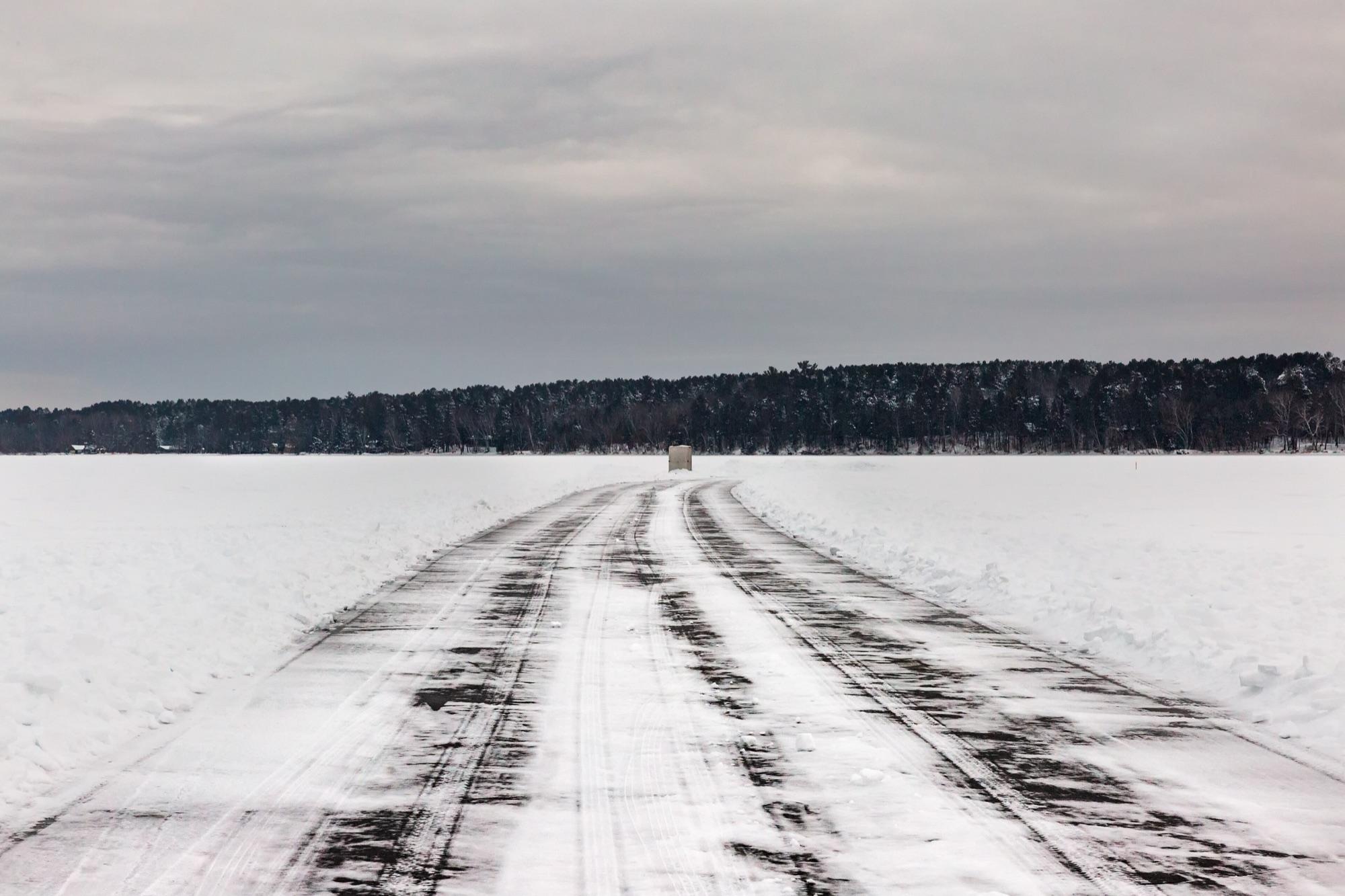
An ice road and fishing house on Fishhook Lake, Park Rapids, December 2018. Not evidence that any ice was or is safe.
Photo: Lorie Shaull, CC BY-SA 4.0. Not taken by MNIRL; resized. Credits
What should I do?
Read from the sources below
Who this applies to
Anyone walking, fishing, snowmobiling or driving onto Minnesota lake ice.
By when
Every trip. Ice changes within a day and across one lake.
Whom to call or check
- Minnesota DNR ice safetyThickness guidelines and gear
- EmergencyCall 911 if someone goes through
What to do
- Read the DNR's ice page before you go and carry the gear it lists.
- Tell someone where you are going and when you will be back.
- Drill and measure as you go. Treat white ice as needing double the clear-ice figure.
- If you are driving, read the DNR's separate parked-load numbers too.
No thickness figure makes ice safe. The DNR does not measure ice on Minnesota lakes. If you are unsure, stay off.
Quick read
- On foot
- At least 4 inches of new, clear ice, per the DNR
- White ice
- The DNR says to double the guideline
- Who measures
- You. The DNR does not measure ice on Minnesota lakes.
- Source
- Official guidance, not a safety assurance. Ice can differ across one lake.
This is not a guide to whether your lake is safe, and nothing here could be. The DNR's page says that it does not measure ice thickness on Minnesota lakes and that your safety is your responsibility. What it does publish is a table of minimums, and that table is worth reading closely, because the conditions attached matter as much as the numbers. Always confirm against the DNR's own page before you go on the ice.
| Ice | Use |
|---|---|
| Under 4 in. | Stay off |
| 4 in. | On foot |
| 5 to 7 in. | Snowmobile or small ATV |
| 7 to 8 in. | Side-by-side |
| 9 to 10 in. | Small car or SUV |
| 11 to 12 in. | Medium SUV or small truck |
| 13 in. | Medium truck |
| 16 to 17 in. | Heavy-duty truck |
| 20 in. or more | Heavy-duty truck with wheelhouse |
What the numbers assume
The table is for new, clear ice. White ice, which forms when snowmelt refreezes and which the DNR describes as about half as strong, needs double the listed thickness. The DNR also says recommendations assume average equipment weight and solid, clear ice, that thickness can vary greatly across a single body of water, and that temperature, wind, snow, streams, springs and sun all affect strength, which is why a reading in one spot tells you about that spot.
Parked is different from moving
The table above is for traveling. A load that stays put needs thicker ice: the DNR lists 6 inches for a person, 10 inches for a snowmobile, and 13 to 22 inches for vehicles depending on weight. It also says vehicles should park at least 50 feet apart and move every two hours. If the ice isn't thick enough to drive on and park away from shore, the page advises against parking on it at all.
| Load | Inches |
|---|---|
| Person standing | 6 |
| Snowmobile (machine and rider under 1,100 lbs) | 10 |
| Loaded vehicle over 1,100 and under 2,200 lbs | 13 |
| Loaded vehicle over 2,200 and under 4,400 lbs | 16 |
| Vehicle over 4,400 and under 6,600 lbs | 18 |
| Three-quarter-ton 4x4 (maximum 11,000 lbs) | 22 |
What to carry
The DNR's gear list starts with a foam life jacket or float suit, since inflatable jackets may not inflate properly in low temperatures. It then lists ice picks, a whistle, a chisel or drill with a tape measure, cleats, a phone in a waterproof case or a locator beacon, and rope. It advises against wearing flotation in an enclosed vehicle on the ice, and says to tell someone where you are going.
If someone goes through
The DNR says to stay where you are instead of walking toward them, call 911, and try to reach them with a rope. Someone climbing out should roll away from the hole instead of standing up. This summarizes the DNR's advice; it is not rescue training.
Common mistakes
Reading the table as a promise: it is a minimum for new, clear ice, not a statement about any lake. Forgetting that parked vehicles need more ice than moving ones. Applying the clear-ice numbers to white ice or to ice with snow cover you cannot see through. Measuring once near shore and assuming the rest of the lake matches. Trusting an old plowed road. The photo at the top shows a snow-covered road on one lake on one day. It is not evidence that any road on any lake is safe.
What differs by place
The DNR's table is statewide and does not adjust for region, lake type or time of winter. It lists no ice-in or ice-out dates and no regional thickness reports. Springs, current and inlets, which the DNR names as hazards, vary by lake, so local knowledge from the bait shop, resort or county sheriff matters; we did not contact any.
What to do
Before you go: read the DNR page, tell someone where you are going and when you will be back, and pack the gear the DNR lists. On the ice: drill and measure as you go, treat white ice as needing double, and stay off if it is under 4 inches. If you are driving, read the parked-load numbers too. If unsure, stay off; no table replaces that decision.
What we could not confirm
Anything about a particular lake today. Whether any local sheriff or resort publishes ice reports for a given lake. Whether the DNR's Alberta-derived stationary figures were adapted for Minnesota conditions beyond what the page states. Rescue effectiveness of the advice; we are summarizing it, not testing it.
How this was made
Primary sources (2)
- State agencydnr.state.mn.us/safety/ice/thickness.html
- State agencydnr.state.mn.us/safety/ice/ice-safety-gear.html
- Date checked
- Sources opened and read on . Rules and prices change; confirm with the source before you act.
- Method
- Desk research. Agency pages and statutes were opened and read on the dates shown, and each claim is tied to the page it came from. Figures we calculated say so. No place was visited and no one was interviewed.
- Review status
- Draft AI research draft, human review pending. No named person has reviewed this page, and nobody from MNIRL has checked it in person. What our labels mean.
What we do not know
- Whether a rule, fee or hour changed after the date checked.
- Anything about a specific place on a specific day: nobody has gone to see.
Found a mistake?
Email rice.john.nextgenai@gmail.com with the page and a source. We review each one and note corrections on the page.
Every claim, with its source
Each line shows what was claimed, the label for how we know, the page it came from and what it does not establish. What these labels mean.
The DNR's thickness table starts at 4 inches of new, clear ice for activity on foot, and the DNR says it does not measure ice on Minnesota lakes.
Official source checkedSource: dnr.state.mn.us · Checked by AI research draft, human review pending
Limits: General guidance only. It says nothing about any particular lake on any particular day.
Double the guidelines on white ice. Stationary loads need 6 to 22 inches depending on the load for more than two hours but under seven days, and parked vehicles should be 50 feet apart and moved every two hours.
Official source checkedSource: dnr.state.mn.us · Checked by AI research draft, human review pending
Limits: The page says its stationary figures come from an Alberta government publication. Re-read in full on 2026-11-06.
The DNR recommends a foam life jacket or float suit, ice picks, a whistle and measuring tools, and advises against flotation in an enclosed vehicle.
Official source checkedSource: dnr.state.mn.us · Checked by AI research draft, human review pending
Limits: This summarizes the DNR's advice. It is not safety training.
If someone falls through, the DNR says to stay where you are, call 911 and try to reach them with a rope.
Official source checkedSource: dnr.state.mn.us · Checked by AI research draft, human review pending
Read next
Illustrative. Photo: Tony Webster, CC BY 2.0. Not taken by MNIRL; resized. Credits
Draft On the water Compiled
Public boat launches in Minnesota: finding one, and what the law expects at the ramp
How to find a public boat launch, what the DNR says is illegal when you leave the water, the cleaning methods it recommends, child life jacket and registration rules with fees, and what the DNR pages do not say.
Illustrative. Photo: Tony Webster, CC BY 2.0. Not taken by MNIRL; resized. Credits
Draft Heat and bills Compiled
Minnesota's Cold Weather Rule: what it protects, and what it doesn't
From October 1 to April 30, Minnesota utilities must follow extra steps before cutting off heat. Which statute applies depends on who sells you the power, and the rule is not a pause on bills.